
AGOV Modules
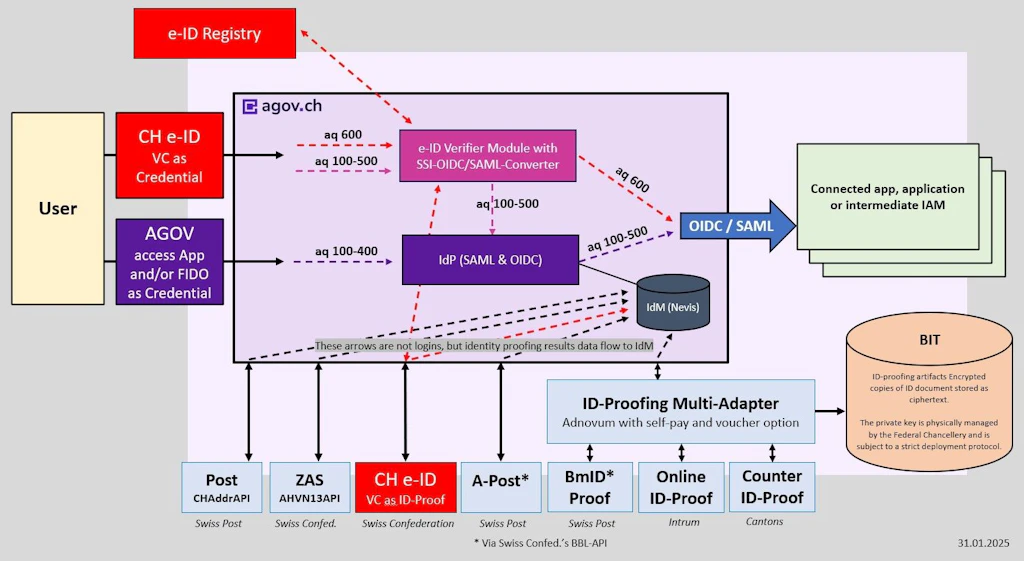
The AGOV ecosystem consists of AGOV modules, peripheral systems, and target systems.
Below you will find the complete list of AGOV modules as well as their publication status in accordance with EMBAG Art 9:
1. AGOV Identity Provider
This module manages user data records and the connection to users’ authentication factors. The AGOV Identity Provider is the product Nevis, whose source code is not available to us (not owned by the Confederation).
2. AGOV Trustbroker
This module acts as an intermediary between the AGOV Identity Provider and the AGOV target systems. Technically, it is a federation using the federation protocols OIDC and SAML.
- Status: Published
- Software name: trustbroker.swiss
- Location: OSS catalog https://www.opensource.admin.ch
3. AGOV Access App
Currently, the AGOV Access App is based on the product Nevis Access App, whose source code cannot be published (not owned by the Swiss Confederation). During the course of 2026, an in-house development will be built around the core of the Nevis Access App, and its source code will be published.
- Status: Will be published by the end of 2026
- Softwar ename: AGOV.Access.App
- Location: OSS catalog https://www.opensource.admin.ch
4. AGOV Counter
This module enables cantons to enter identity verification results into AGOV, typically as part of ID checks at a service counter.
- Status: Will be published by the end of 2026
- Software name: AGOV.Counter
- Location: OSS catalog https://www.opensource.admin.ch
5. AGOV View
This module enables support organizations to view the status of AGOV user accounts.
- Status: Will be published by the end of 2026
- Software name: AGOV.View
- Location: OSS catalog https://www.opensource.admin.ch
6. AGOV Verifier
This module connects AGOV with the e-ID ecosystem.
- Status: Will be published by the end of 2026
- Software name: AGOV.Verifier
- Location: OSS catalog https://www.opensource.admin.ch
7. AGOV Self-Service Ticket Form
This module allows end users to open a support ticket in self-service. The source code will be published by the end of 2026, excluding the underlying ticket management system “Halo ITSM” (not owned by the Swiss Confederation).
- Status: Will be published by the end of 2026
- Software name: AGOV.Self.Service.Ticketformular
- Location: OSS catalog https://www.opensource.admin.ch
8. AGOV Peripheral Systems
The AGOV peripheral systems CCO, CH e-ID, A Mail, LID, as well as the ID-Proofing-Multi-Adapter are not part of the AGOV project’s source code publication. This is because they either do not fall under the responsibility of the Federal Chancellery (CCS and CH e-ID) or represent services from the private sector (all other systems).
9. AGOV Target Systems
AGOV target systems are so-called relying parties connected to AGOV in order to obtain authentication services, for example cantonal portals for submitting tax returns. These are, of course, not part of the AGOV project’s source code publication.