
NEST to celebrate its 10th anniversary: A crystal ball for the building sector
Dübendorf, 30.09.2026 — In 2016, a new chapter began on the Empa campus in Dübendorf with the launch of NEST. Its ambitious goal: The innovation platform, which serves as a demonstrator for the built environment, is intended to help develop more sustainable solutions for the building stock more quickly. After ten years, the results are indeed positive: ten innovative construction projects, a network of around 150 partners, and several innovations that have made it to market.
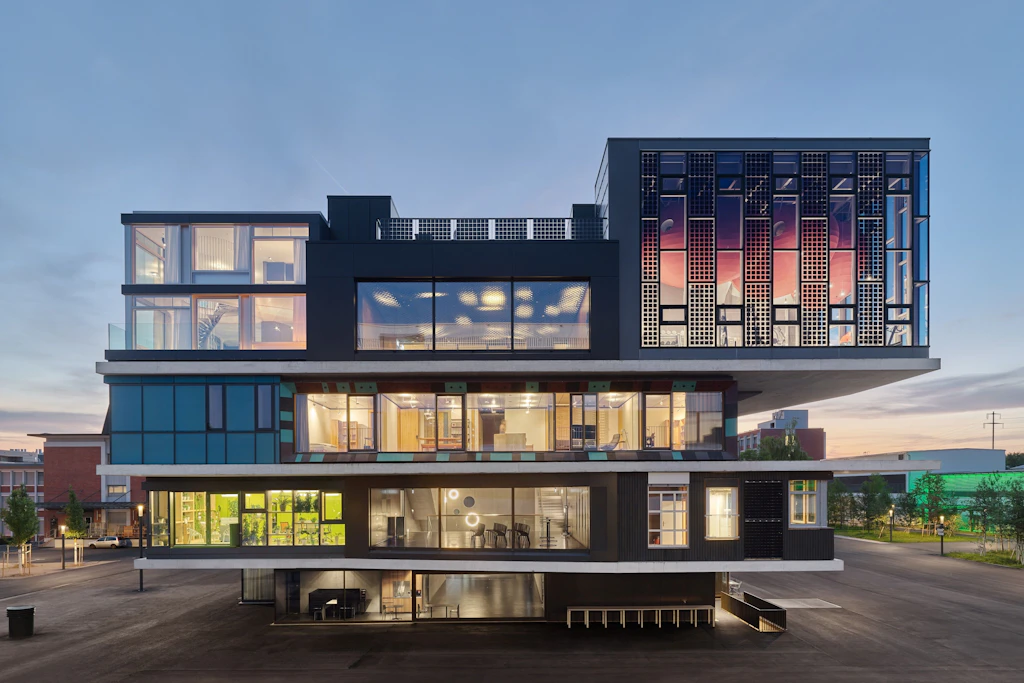
What will buildings, such as offices and apartments, look like in the future, taking into account dwindling resources and the need to reduce emissions? And just as important: How can we turn interesting new solutions into market-ready products? Facing these questions, the modular research and innovation platform NEST, short for Next Evolution in Sustainable Building Technologies, was opened in 2016.
This joint project between the research institutes Empa and Eawag was initiated at a time when it was becoming clear that new solutions were needed in the field of building construction – solutions that would contribute to the net-zero goal for 2050 and accelerate innovation cycles in the construction sector. At the same time, NEST was able to build on several predecessor projects that had already taken the first steps toward novel construction methods. “Projects such as the Monte Rosa Hut and the self-sufficient living container ‘SELF’ already made it apparent, that we were able to convince many people of the importance and success of sustainable concepts in the building sector,” says Peter Richner, former deputy director of Empa and founder of NEST. “As a consequence, we already had a great deal of goodwill with the federal government, cantonal authorities, and municipalities, where we found a receptive audience for NEST’s ambitious goal.” After all, such a cost-intensive project was only conceivable thanks to substantial support from the Canton of Zurich and the municipality of Dübendorf, as well as the ETH Domain and a number of industry partners.
An incubator for new technologies and systems
And what has happened since the inauguration? Over the past ten years, ten modular buildings, known as units, have been constructed, each dedicated to specific challenges and technologies. Terms such as digital prefabrication, circular construction, and predictive control were still purely niche topics in the building sector ten years ago. Thanks in part to the visionary NEST units, these topics are now increasingly being incorporated into the planning and implementation of new construction projects. However, the potential for sustainable concepts and products in the industry is far from exhausted. In 2023, the Canton of Zurich and numerous industry partners signed the Circular Construction charter, a declaration of intent designed to set the course for sustainable resource management in the areas of procurement, planning, construction, and demolition.
In total, more than ten startups have emerged from research and projects within NEST, driving the sustainable transformation of the construction industry with promising innovations in the areas of structural engineering, energy management, and wastewater management. And Peter Richner adds: “NEST’s strength lies precisely in the fact that stakeholders from various sectors can examine current challenges, validate solutions, and derive future strategies in a real-world setting. Therefore, you could describe NEST as a kind of ‘crystal ball’ for questions related to the built environment.”
In the field of digital technologies, for example, the National Center of Competence in Research in Digital Fabrication (NCCR DFAB), based at ETH Zurich, has further developed numerous new design and manufacturing tools over the past twelve years. At the same time, the program has produced an entire generation of experts and spin-offs dedicated to transforming the construction sector. The NEST units DFAB-House and HiLo – each representing a distinct design for innovative residential and office buildings – played a key role in this development. In addition to their peculiar, structurally optimized geometries, these projects also feature a hybrid timber-concrete construction method and automated building control systems. The two NEST units served as flagship projects for the research program, as they enabled the highly realistic implementation and validation of various technologies and methods. In the words of Russell Loveridge, project manager for NCCR DFAB: “For the construction industry to seriously engage with new ideas and concepts, it needs real proof that what we’re developing in our research actually works. In this regard, NEST was an essential factor in our work, bringing research and industry closer together and making many collaborations possible in the first place.” What makes NEST special, he says, is that the units didn’t really set any limits but instead allowed a great deal of freedom for research and development: “If something didn’t work out the way we’d envisioned it during planning, that was never a setback – it was always an opportunity for us to refine our methods and adjust our processes,” says Loveridge.
From ideas to innovations
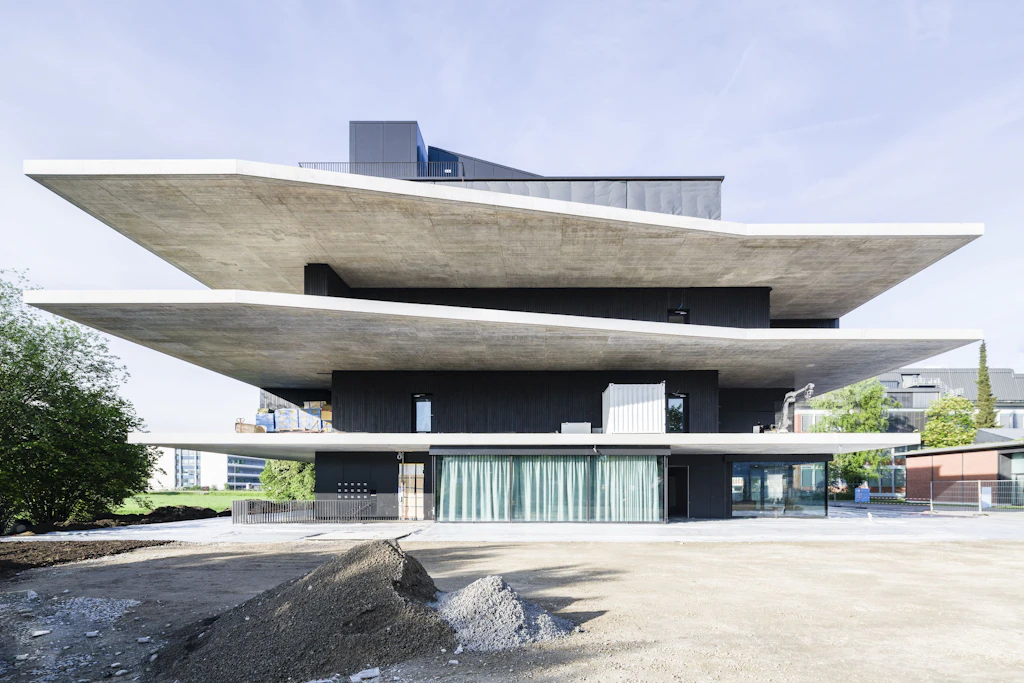
The logical next step, which was taken quite literally in 2024 with the unit STEP2, is to transform innovative concepts from actual prototypes at NEST into market-ready products. In addition to compelling design and proven emissions reductions, this requires one thing above all else: a business case. Enrico Marchesi, Innovation Manager at NEST, who was responsible for developing the STEP2 unit, among other things, is well aware of this: “An innovation is only an innovation if it can be sold. Otherwise, it’s merely an invention that isn’t put to use and therefore provides no benefit.”
Ultimately, he and Managing Director Reto Largo measure NEST against this very standard. That is why market viability was a top priority during the development of STEP2: Unlike in earlier projects, the components used were to be available for immediate order at the time of opening. This was particularly successful in the case of the innovative floor slab, which combines resource savings with added comfort: Thanks to digital planning and prefabrication, CO2 emissions were reduced by about 40 percent compared to a conventional flat concrete slab. At the same time, the floor system features integrated acoustic insulation and can be used as passive thermal mass.
With the floor system developed by Vaulted AG, a spin-off of the Philippe Block Group at ETH Zurich, a second structural solution has made the journey from prototype at NEST to finished product, resulting in significant reductions in material use and CO2 emissions. These examples show that identifying significant potential for savings, combined with an innovative solution, will sooner or later lead to new products that generate genuine interest among designers and building owners.
Always one step ahead
For Reto Largo, close collaboration with partners in the construction industry will clearly remain a central focus in future projects as well: “With our next unit, Beyond.Zero, we are deliberately tackling a novel topic: the development of CO2-negative building materials and insulation based on the use of biochar. We expect this to lead to buildings that can act as carbon sinks in the future.” Various external partners are involved in the material development process to ensure that scaling up and market launch can proceed as quickly as possible. In the long term, the goal is to replace natural biochar with synthetically produced charcoal made from atmospheric CO2. Several research projects at Empa have already demonstrated that this is indeed technologically valid not merely a utopian dream.
Matthias Sulzer, head of the Engineering Sciences department at Empa, has high hopes for Beyond.Zero. as well. He is convinced: “The potential offered by these carbon sinks in the building stock is enormous. If we succeed not only in demonstrating that it’s possible to build this way, but also in scaling up these products through our industry partners, then we’ll take a major leap toward achieving our climate goals.” For him, too, collaboration between research and industry remains crucial. However, he sees another cornerstone for the future development of NEST: “Today, we’re seeing research and development becoming more firmly embedded in companies in the construction sector. To ensure we can continue to contribute to the innovation process in the best possible way, it’s essential that NEST serves not only as a demonstrator but also as a vibrant network, in the sense of a community, for interdisciplinary collaboration.”
After ten years of NEST, everyone agrees on one thing: Even over the next 50 years, we won’t be building in any fundamentally different way than we do today. What will – and must – change, however, are planning, products, processes, and price levels. Thanks to digital tools, we can work much more efficiently today than we could 20 years ago, which is why even higher-quality solutions don’t necessarily have to be more expensive. For Reto Largo, one thing is clear: “The question is not whether or not sustainable innovations can establish themselves as new standard products, but rather when. That is, if we continue to consistently bring together research, industry, and customers. With NEST, we have a unique playground at our disposal that allows us to rethink buildings, try out new things, and be bold in the development process.”
Anyone who wants to immerse themselves in the exciting NEST units and get a sense of innovative solutions in the building sector can do so on our virtual tour.
Further information
Reto Largo
CEO NEST
Phone +41 58 765 65 63
reto.largo@empa.ch